
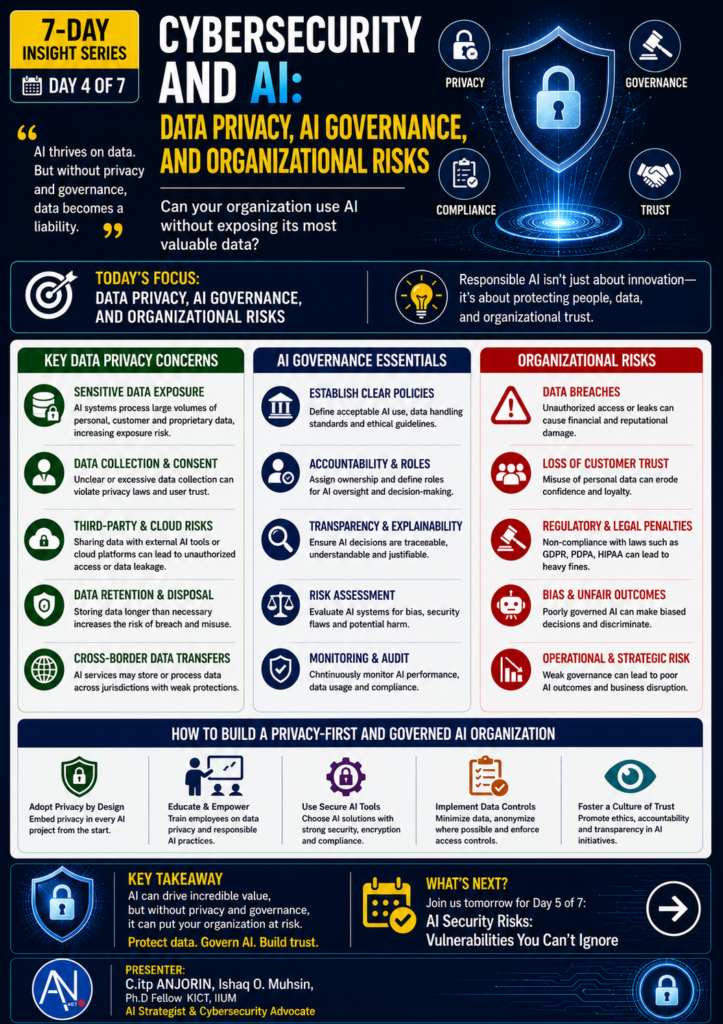
7-Day Cybersecurity & AI Insight Series | Day 4 of 7
Artificial Intelligence is transforming how organizations innovate, make decisions, and deliver value. From customer service and predictive analytics to automation and decision support, AI is becoming an integral part of modern business operations.
However, there is a fundamental reality that every organization must understand:
AI is only as trustworthy as the data it is built upon and the governance that surrounds it.
AI systems rely on vast amounts of data to learn, adapt, and generate insights. This data often includes customer information, employee records, financial transactions, proprietary research, and other sensitive organizational assets. Without proper governance, these valuable assets can become significant liabilities.
One of the greatest misconceptions surrounding AI adoption is that deploying an AI solution automatically creates business value. In reality, organizations that adopt AI without robust governance expose themselves to unnecessary operational, legal, and reputational risks.
Key Data Privacy Challenges
🔒 Sensitive Data Exposure
Employees may unintentionally upload confidential business documents, customer records, source code, financial reports, or intellectual property into public AI platforms. Once sensitive data leaves the organization’s controlled environment, the risk of unauthorized access or unintended disclosure increases significantly.
☁️ Third-Party and Cloud Risks
Many AI services operate in cloud environments managed by external providers. Organizations must understand where their data is stored, how it is processed, who has access to it, and whether it complies with applicable privacy regulations.
🌍 Cross-Border Data Transfers
AI platforms may process data across multiple countries. This raises important legal and regulatory questions regarding jurisdiction, data sovereignty, and compliance with international privacy requirements.
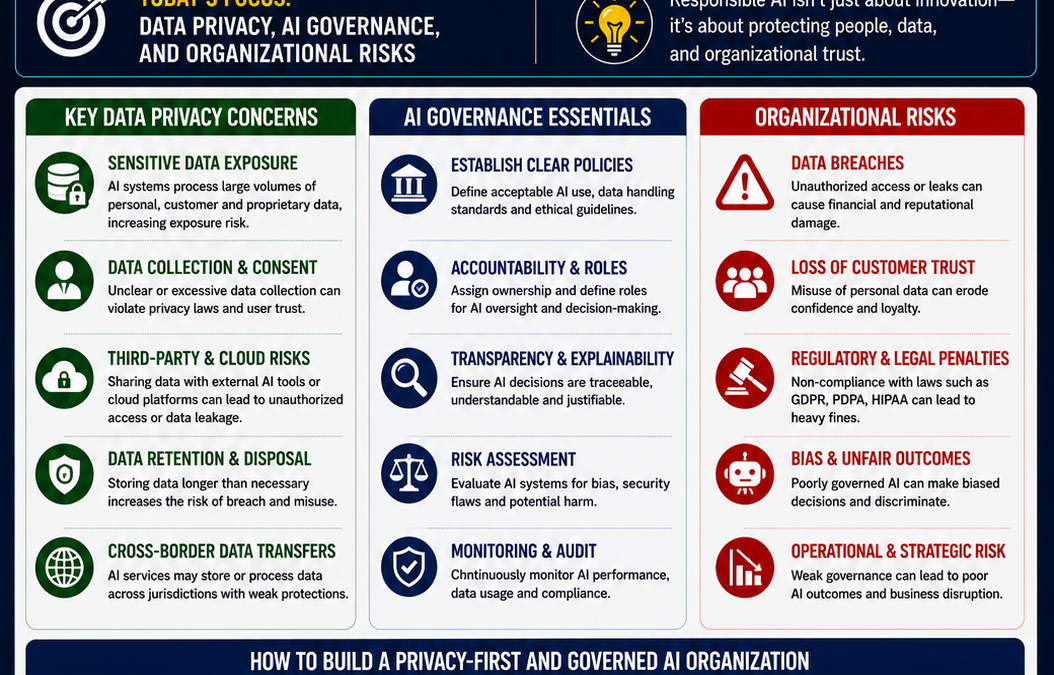
Data Privacy, AI Governance, and Organizational RisksWhy AI Governance Matters
AI governance is more than a compliance exercise—it is a strategic framework that ensures AI technologies are deployed responsibly, securely, ethically, and transparently.
Effective AI governance enables organizations to:
- Establish clear policies for AI usage
- Define accountability and oversight
- Protect sensitive information
- Reduce bias and improve fairness
- Ensure regulatory compliance
- Build trust with customers, employees, and stakeholders
Organizations that govern AI effectively are better positioned to innovate with confidence while minimizing operational and cybersecurity risks.
Organizational Risks of Poor AI Governance
Without proper governance, organizations may face:
- Data breaches and unauthorized disclosure
- Loss of customer trust and brand reputation
- Regulatory investigations and financial penalties
- Biased or inaccurate AI-driven decisions
- Increased operational and strategic risks
These challenges are no longer hypothetical—they are becoming everyday realities for organizations adopting AI without appropriate safeguards.
Building a Privacy-First AI Culture
Technology alone cannot solve governance challenges. Organizations must cultivate a culture where responsible AI becomes part of everyday decision-making.
This includes:
- Embedding Privacy by Design into AI initiatives
- Developing comprehensive AI governance policies
- Training employees on responsible AI practices
- Conducting regular AI risk assessments and audits
- Continuously monitoring AI systems for security, compliance, and ethical performance
Responsible AI is not about limiting innovation—it is about ensuring innovation remains trustworthy, secure, and sustainable.
🛡️ Key Takeaway
AI can unlock tremendous business value, but without strong data privacy and governance, it can also expose organizations to significant legal, operational, and cybersecurity risks.
The organizations that will lead in the AI era are not simply those that adopt AI the fastest, but those that build trust, transparency, accountability, and resilience into every stage of their AI journey.
#Cybersecurity #ArtificialIntelligence #AI #DataPrivacy #AIGovernance #ResponsibleAI #CyberResilience #InformationSecurity #DigitalTrust #BusinessLeadership #RiskManagement #DataProtection #DigitalTransformation
