
For many Nigerians, the announcement that the Federal Government has begun enforcing the new National Identity Management Commission (NIMC) Act may appear to be just another update to the National Identification Number (NIN) programme. However, this legislation represents something much bigger than a routine policy change. It marks the beginning of a new digital identity era that could redefine how Nigerians access services, conduct business, and establish trust in the digital economy.
The newly enacted law replaces the 2007 NIMC Act with a broader legal framework designed to modernise identity management, strengthen cybersecurity, improve data protection, and support Nigeria’s growing digital economy. Rather than treating identity as merely a physical card or a number, the Act positions digital identity as critical national infrastructure.
More Than an Identity Number
For years, millions of Nigerians associated the NIN primarily with SIM registration, bank verification, passport applications, and access to government programmes. While these functions remain important, the new legal framework expands the role of digital identity far beyond administrative compliance.
Identity is now expected to become the trusted foundation for digital transactions, electronic signatures, secure online authentication, and seamless access to both public and private digital services. The law effectively transforms NIMC into a national trust authority capable of supporting secure digital interactions across government and industry.
A Major Win for Nigeria’s Digital Economy
Nigeria’s ambition to build a thriving digital economy depends on one essential ingredient: trust.
Banks need to verify customers instantly.
Fintech companies need secure onboarding.
E-commerce platforms must reduce identity fraud.
Healthcare providers require reliable patient identification.
Government agencies need accurate citizen records.
Without trusted digital identity, these systems become slower, more expensive, and more vulnerable to fraud.
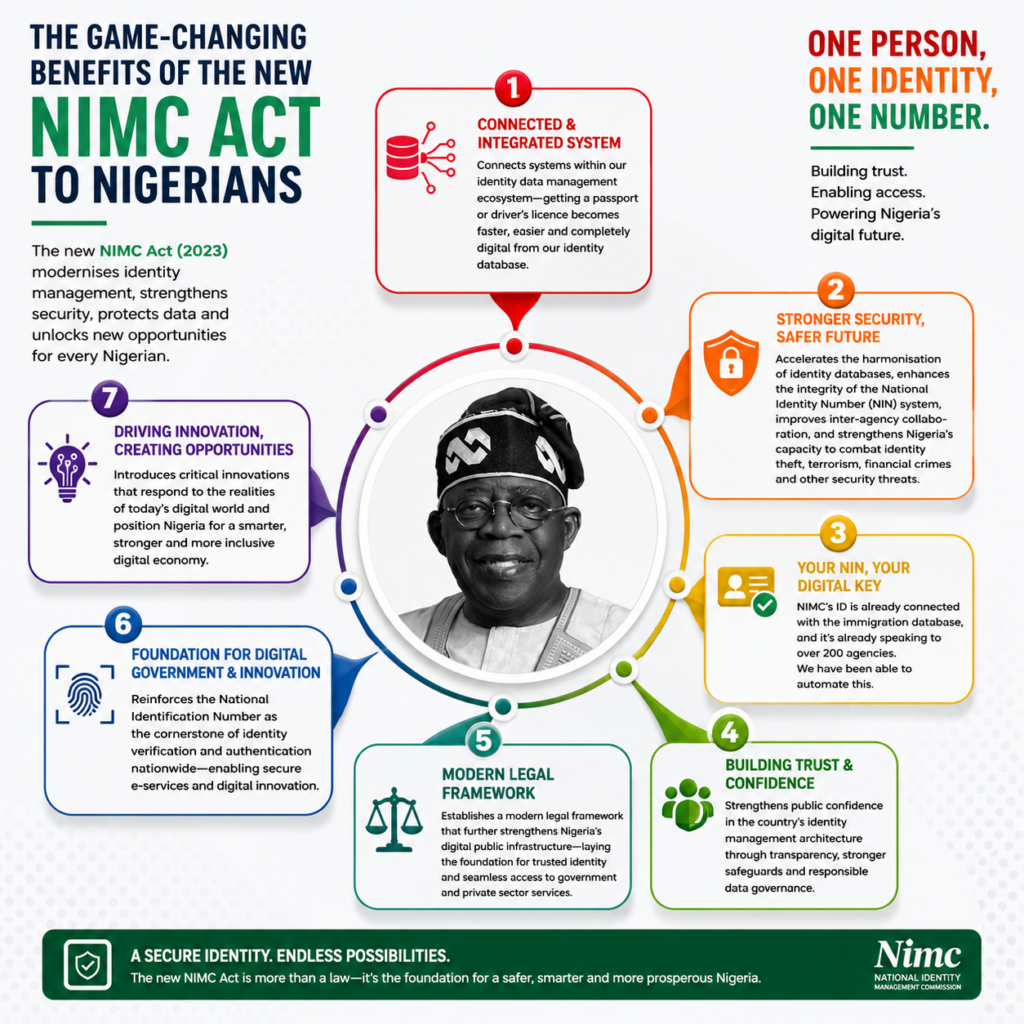
The new Act provides the legal foundation for stronger identity verification mechanisms, enabling secure digital services while reducing impersonation and identity-related crimes.
Goodbye Physical Cards, Hello Digital Identity
One of the most significant shifts introduced by the law is the move away from dependence on physical identity cards.
Instead, Nigerians will increasingly verify their identities through digital credentials, biometric authentication, QR codes, mobile applications, and other secure digital verification methods. This aligns Nigeria with global trends where digital identity is replacing traditional plastic identity cards as the preferred means of authentication.
For citizens, this promises greater convenience. For businesses, it offers faster customer verification and reduced operational costs. For government, it creates opportunities to deliver more efficient digital public services.
Stronger Protection Against Identity Fraud
Nigeria has experienced increasing cases of identity theft, cyber fraud, SIM-related scams, and unauthorised use of personal information.
The new law responds by introducing significantly tougher penalties for identity fraud and unauthorised access to identity databases. It also grants stronger investigative powers to tackle identity-related offences, while imposing stricter obligations on organisations that process identity information.
For cybercriminals, identity theft is no longer simply an IT issue—it becomes a far more serious criminal offence with enhanced legal consequences.
Privacy Must Remain a National Priority
While the legislation strengthens identity management, it also raises important conversations around privacy and responsible data governance.
Digital identity systems can unlock innovation only when citizens have confidence that their personal information is secure and handled transparently. The Act therefore reinforces consent-based data sharing and aligns identity management more closely with Nigeria’s broader data protection framework.
Technology alone cannot build trust; public confidence depends on effective governance, accountability, and continuous investment in cybersecurity.
What This Means for Businesses
The impact of the new law extends well beyond government agencies.
Banks, fintech firms, insurers, telecommunications companies, healthcare providers, educational institutions, and e-commerce platforms are all likely to adapt their identity verification processes to align with the new framework.
Businesses that embrace secure digital identity solutions early are likely to benefit from improved customer onboarding, lower fraud rates, streamlined compliance, and stronger digital trust.
The Road Ahead
The true success of Nigeria’s new identity framework will not be measured by the number of NINs issued but by how effectively it enables secure digital interactions across the economy.
Implementation will be critical. Digital infrastructure, interoperability, cybersecurity readiness, public awareness, and institutional collaboration must evolve together to realise the law’s full potential.
If executed effectively, this legislation could become one of the foundational pillars of Nigeria’s digital transformation, enabling trusted digital services, accelerating innovation, attracting investment, and positioning the country more competitively in the global digital economy.
For Nigerians, the message is clear: this is no longer just about obtaining a NIN. It is about participating in a future where digital identity becomes the key that unlocks secure access to financial services, healthcare, education, e-government, and countless opportunities in an increasingly connected world.
